We've been quietly going to another church since January. People, I know, switch churches all the time for all kinds of reasons. But we'd been going to the same Catholic church since we moved here in late 2006: both girls in Sunday School, me volunteering, Jason cantoring, a fair amount of familiar faces. And Jason and I have been going to a Catholic church in one form or another since we were married, after a few months of struggling to figure out how, exactly, we were going to meld our different ideas about God and communion and worship into something that would work for our entire future family. He grew up Catholic, I didn't, and a bunch of factors (some more legitimate than others) swayed us to choose his tradition.
The new church isn't Catholic.
I love the new church so much I could almost cry just thinking about it.
*****
You know how some people make a very big deal out of eating corned beef and cabbage on St. Patrick's Day? Well, maybe you don't, but I do, because I live with one. Jason has little - if any - Irish blood in his background, but he loves to buy a giant corned beef sometime mid-March, get his hands on a can of cabbage or two, and boil up a big, stinky Irish dinner for the holiday, even if he's the only person in our family who will eat it. He genuinely loves the taste, and he's adopted the tradition as his own. There's something joyful and meaningful to him about celebrating the holiday that way. He likes to have a few guys over, carve the beef into slices for reubens, and watch March Madness basketball. He likes the way the meal reminds him that spring is just around the corner. He likes how it smells and how it tastes.
In other, more Irish parts of the country, I imagine there are whole Irish families who annually celebrate in much the same way. It's part of their culture, and their grandmother or dad has been cooking this meal on March 17 for as long as they can remember. There are probably people in those families who don't necessarily love the taste of the beef or the smell of the cabbage, but they look forward to the holiday because of the tradition it represents and because it's a tie to their heritage. They eat the dinner. And even if the specific food is not their favorite, they likely enjoy the familiar celebration.
*****
The Catholic Church had become like corned beef and cabbage to me. After over a decade of practicing the faith, it had never come to feel familiar. I had never been able to embrace the tradition it represents or connect with its culture. In addition, I had not been able to embrace it as an outsider, either; I don't genuinely like how it tastes and smells, it's not joyful or meaningful to me, and I wouldn't want to adopt it as my own.
Here's the thing: because I didn't genuinely enjoy it, and because I wasn't connecting with it out of familiar tradition, I had stopped eating it at all. I'd forgotten that there was a time in my life when I looked forward to going to church, when I genuinely enjoyed the traditions and connections, when I left church feeling like I'd been gathered around the table at my grandparents' house and was going back out to the world, fortified for the week and reminded of how loved I was. So I didn't want to go, ever, at all, period.
*****
I have plenty of friends and family who find joy and meaning in the Catholic church, either because they genuinely appreciate the doctrine and worship style or because it's been a big part of their cultural and familial tradition for years. It's their home, or it's their adopted home, and they find joy and meaning and delicious sustenance there, and I am so very happy for them about that. But as our girls grew older and as Jason and I thought more about the messages we want them to hear and see, the Catholic church wasn't working for us.
So a few months ago we went to not-a-Catholic church again for the first time in ages. We've been going pretty regularly. And we never leave without a deep sense of gratitude that we spent an hour there. I remember the first time we were there for communion and the minister gave a little spiel that went something like, We don't presume you to be Christian in a certain way; it is simply our hope to be Christian to you. And that means that absolutely everyone is welcome here, and that anyone with any shred of belief is welcome to join us around this table, and I could have wept on the spot with relief. The rules and dogma and doctrinal scoldings at our old church left me feeling resentful, beaten down, and defeated. The Catholic church, when asked, "What are you sure of?" replies: "Everything. Fall in line." But here - here! right in our city - was a church that, when asked the same question, replies: Barely anything. But come figure it out with us.
Don't get me wrong; I like rules: speed limits, bedtimes, ask-to-be-excused-before-you-leave-the-table, pay your taxes, wait in line, be a good neighbor. But when it comes to God, I've long gone on record as being a little suspicious of anyone who seems to be too sure about anything. It is a MYSTERY. Who among us can really know much for sure beyond the Greatest Commandment (Love God) and the second, "like unto it," (Love one another)? Why raise our girls in a church where they, no matter how holy or wise or effective a leader, can't lead because of their gender? Why endure doctrinal scoldings during sermons about things that we never agreed with in the first place? Why remain a part of a church that wants to silence dissension, keep people away from the table, and offer communion based on a set of narrow parameters?
From now on, we'll be over here, eating at a table that nourishes us, celebrating the hol(y)days in a way that makes better sense to us, creating our own little family traditions.
Showing posts with label Deep Thoughts. Show all posts
Showing posts with label Deep Thoughts. Show all posts
Wednesday, August 6, 2014

Monday, February 10, 2014
Beatrice
My grandma passed away yesterday. She was my mom's mom, the grandma I was closest to growing up. The one who had us over for sleepovers and let us shoot BB guns off the back porch at leftover utility line flags. The one with a huge backyard with a clothesline and a basement with spare bedrooms where my brother and I slept. The one who loved crossword puzzles and spoke German and Dutch and wrote me long letters from Florida in the winter, with spidery handwriting and drawings of the layout of their condo and maybe five or ten dollars inside. The one who was always doing dishes or wiping the counter. The one who served Ritz crackers and Schuler's bar cheese on Sundays when we went for coffee after church, who poured me iced tea out of a brown Tupperware pitcher. The one who came to all my birthday parties, hosted our Christmas Eve gatherings, went on our annual summer camping trip, cooked me the best fried potatoes ever with the container of bacon grease she kept under the sink. The one who came to the hospital to hold baby Annie on her first day of life. The one who canned peaches and pears and made strawberry jam and drove a school bus for disabled kids.
She was smart, stubborn, fastidious, faithful, and serious, though I remember her laughing a lot too. She drank coffee from morning to night. She smelled like lipstick and lotion. She had Alzheimer's, like her own mother did, and she hasn't been the same grandma to me for at least five years now. I brought her flowers and ate cake with her on her birthday in October. I saw her last weekend and I was stunned. She was less like my grandmother and more like a baby bird, lying in bed, unable to talk, unable to eat, opening her eyes off and on when we spoke to her or held her hand. For the last week, the image has been with me as I go about all the things I go about. As I was falling asleep, I was thinking My grandma is dying. As I stretched my hamstrings in downward dog, I was thinking My grandma is dying. As I hugged and kissed the girls when they got home from school, I was thinking My grandma is dying. As I took a bite of food, laughed with a friend, wrote an article, drove my car, shoveled snow, talked to my mom on the phone, read to my daughter before bed: My grandma is dying.
And now she's gone. She leaves behind my grandpa, her husband of 64 years, a number that is incomprehensible to me, and her four children, her grandchildren, her great-grandchildren. I am at once guiltily relieved that she is no longer suffering in that bed and incredibly sad that she is no longer in the world with me. I'll never hold her hand again. I'll never smell her smell. Two months ago, I still had both my grandmas; now I have neither.
I have friends who have lost parents, siblings, unborn children. This -- me losing my grandparents in their 80s and 90s -- is not particularly tragic, I know. It's simply sad. So for today, I'm trying to get down the good memories as best I can before they fade. I'm trying to find the threads of these two beautiful, smart, funny, strong, stubborn women in myself and in my girls. I'm trying to remember that, in the word of a favorite, Ray Bradbury, "no person ever died that had a family."
"Important thing is not the me that's lying here, but the me that's sitting on the edge of the bed looking back at me, and the me that's downstairs cooking supper, or out in the garage under the car, or in the library reading. All the new parts, they count. I'm not really dying today. No person ever died that had a family. I'll be around a long time. A thousand years from now a whole township of my offspring will be biting sour apples in the gumwood shade." - Ray Bradbury, Dandelion Wine
She was smart, stubborn, fastidious, faithful, and serious, though I remember her laughing a lot too. She drank coffee from morning to night. She smelled like lipstick and lotion. She had Alzheimer's, like her own mother did, and she hasn't been the same grandma to me for at least five years now. I brought her flowers and ate cake with her on her birthday in October. I saw her last weekend and I was stunned. She was less like my grandmother and more like a baby bird, lying in bed, unable to talk, unable to eat, opening her eyes off and on when we spoke to her or held her hand. For the last week, the image has been with me as I go about all the things I go about. As I was falling asleep, I was thinking My grandma is dying. As I stretched my hamstrings in downward dog, I was thinking My grandma is dying. As I hugged and kissed the girls when they got home from school, I was thinking My grandma is dying. As I took a bite of food, laughed with a friend, wrote an article, drove my car, shoveled snow, talked to my mom on the phone, read to my daughter before bed: My grandma is dying.
And now she's gone. She leaves behind my grandpa, her husband of 64 years, a number that is incomprehensible to me, and her four children, her grandchildren, her great-grandchildren. I am at once guiltily relieved that she is no longer suffering in that bed and incredibly sad that she is no longer in the world with me. I'll never hold her hand again. I'll never smell her smell. Two months ago, I still had both my grandmas; now I have neither.
I have friends who have lost parents, siblings, unborn children. This -- me losing my grandparents in their 80s and 90s -- is not particularly tragic, I know. It's simply sad. So for today, I'm trying to get down the good memories as best I can before they fade. I'm trying to find the threads of these two beautiful, smart, funny, strong, stubborn women in myself and in my girls. I'm trying to remember that, in the word of a favorite, Ray Bradbury, "no person ever died that had a family."
"Important thing is not the me that's lying here, but the me that's sitting on the edge of the bed looking back at me, and the me that's downstairs cooking supper, or out in the garage under the car, or in the library reading. All the new parts, they count. I'm not really dying today. No person ever died that had a family. I'll be around a long time. A thousand years from now a whole township of my offspring will be biting sour apples in the gumwood shade." - Ray Bradbury, Dandelion Wine
Thursday, July 18, 2013
Nightly News
It's the third or fourth ninety-something-degree day in a row this morning, so I quit trying to do anything productive (press releases, piano concert promotion, articles due, email) and declare that we're going to the pool. On the way there, Annie, per usual, is both looking at a library book and chatting up a storm.
" . . . And then in book 22 of Cam Jansen, the teacher gets arrested!"
Me: "Hmmm."
Annie: "But then I bet they find out that someone else is the thief."
Me: "Mmmmm-hmmmmmm."
Annie: "Because a teacher wouldn't ever do anything bad like that, right?"
Me, stalling: "Hmmm?"
Annie: "RIGHT?"
Me, brightly: "Not any teacher that I've ever known!"
*****
When Jason and I were gone last month, I left behind a four-page, single-spaced Microsoft Word document to instruct the grandparents on how to live our life at our house. It included exciting details such as how much to feed the cats, library card pin numbers, pediatrician phone numbers, when to put out the trash, how to get to tennis camp, how to leave the washing machine door ajar so as to avoid mildew on the seal, and where to find spare toilet paper (in the "Costco pantry" in the basement, obviously). It also included a paragraph that went something like:
"The girls may watch cartoons on PBS or Nick Jr. on demand, usually for no more than an hour at a time. They both know how to get to math and typing games on the computer, but no computers in bedrooms. Please don't have the news on while they're awake or around; we don't watch the news around them."
My parents came over for the afternoon a week or so before we were scheduled to leave, so they could look over the instructions and get familiar with the various machines and procedures, and my mom stopped abruptly when she read this section of the document.
"You don't let them see the news?" she asked.
"Nope. Not really," I said.
"Well, why not?" she said.
"Well, we actually don't watch it, anyway - never really have - and there's a lot of stuff on there that we don't especially want to explain to them yet, at ages six and eight," I said.
My mom made a face. "Well, they have to learn about the world eventually," she said, and it was clear that she disagreed with our policy.
The reason I gave her is partially true: Jason and I really don't watch the news, nightly, cable, morning or otherwise. I remember watching CNN in college during the Clinton scandal, and I actually like to catch the occasional "Meet the Press" or newsy roundtable on the treadmill from time to time, but most news these days seems like sensationalistic fear-mongering and incomplete sound-bytes. It raises my anxiety level and makes me feel helpless and depressed, and we don't turn it on. So our television-news-free house would probably be television-news-free even if we were also child-free.
I do, however, consume news. I read it online, and I listen to it on NPR. I like the longer, nuanced, in-depth perspectives that those formats provide, and sometimes I'll even take the time to read the comments on an article (though never, ever on MLive, where the commenters make you lose your faith in humanity), because they can poke holes in or confirm the conclusion of an article. And even when I do those things, I still shield the kids from it. I minimize the website when they come in the room. I turn off NPR when they're in the car on the way to the pool, asking their mostly-innocent questions about teachers and morality.
Why? I suppose I want to tell them the truth ("No teacher I've ever known!") but not the whole truth ("Some teachers would."). I suppose I want them to just BE KIDS for a bit longer, to let them make fairy houses and read mysteries and cannonball into the pool without letting them worry about a Florida teenager shot by a neighborhood watch patrol, without explaining bankruptcy or celebrity drug use or armed robbery or protests in Egypt.
Later, after we returned from our trip, I surveyed a few friends: Did they let their kids watch the news? The answer, resoundingly, was no. They didn't. Why, asked one mom, give them information that they can't do anything about? Why, asked another, fuel an anxiety-prone child by providing video footage of real-life nightmares? I decidedly don't want to shelter my girls from the reality of the world. But I don't want to push them too quickly into it, either, and I don't think I'm alone.
I can't remember, exactly, when I learned about the world and all the events on the nightly news. Based on my mom's reaction, I think I'm correct in remembering that the 6:00 news was always on in our living room after dinner, though I don't have any concrete memories of it beyond being shushed during the weather report. I remember watching The Challenger explode at takeoff in third or fourth grade, and then I remember watching the first Gulf War begin at some point during middle school. Between those two events, it's static, nothing.
Rationally, I know that there's a time, just around the proverbial corner, when Annie - and, later, Jemma - will deserve to know what's happening, and will need my help in interpreting it all. I just can't quite find the conviction that it needs to happen yet. Maybe next year, I think as we pull into the pool parking lot. Or the next.
" . . . And then in book 22 of Cam Jansen, the teacher gets arrested!"
Me: "Hmmm."
Annie: "But then I bet they find out that someone else is the thief."
Me: "Mmmmm-hmmmmmm."
Annie: "Because a teacher wouldn't ever do anything bad like that, right?"
Me, stalling: "Hmmm?"
Annie: "RIGHT?"
Me, brightly: "Not any teacher that I've ever known!"
*****
When Jason and I were gone last month, I left behind a four-page, single-spaced Microsoft Word document to instruct the grandparents on how to live our life at our house. It included exciting details such as how much to feed the cats, library card pin numbers, pediatrician phone numbers, when to put out the trash, how to get to tennis camp, how to leave the washing machine door ajar so as to avoid mildew on the seal, and where to find spare toilet paper (in the "Costco pantry" in the basement, obviously). It also included a paragraph that went something like:
"The girls may watch cartoons on PBS or Nick Jr. on demand, usually for no more than an hour at a time. They both know how to get to math and typing games on the computer, but no computers in bedrooms. Please don't have the news on while they're awake or around; we don't watch the news around them."
My parents came over for the afternoon a week or so before we were scheduled to leave, so they could look over the instructions and get familiar with the various machines and procedures, and my mom stopped abruptly when she read this section of the document.
"You don't let them see the news?" she asked.
"Nope. Not really," I said.
"Well, why not?" she said.
"Well, we actually don't watch it, anyway - never really have - and there's a lot of stuff on there that we don't especially want to explain to them yet, at ages six and eight," I said.
My mom made a face. "Well, they have to learn about the world eventually," she said, and it was clear that she disagreed with our policy.
The reason I gave her is partially true: Jason and I really don't watch the news, nightly, cable, morning or otherwise. I remember watching CNN in college during the Clinton scandal, and I actually like to catch the occasional "Meet the Press" or newsy roundtable on the treadmill from time to time, but most news these days seems like sensationalistic fear-mongering and incomplete sound-bytes. It raises my anxiety level and makes me feel helpless and depressed, and we don't turn it on. So our television-news-free house would probably be television-news-free even if we were also child-free.
I do, however, consume news. I read it online, and I listen to it on NPR. I like the longer, nuanced, in-depth perspectives that those formats provide, and sometimes I'll even take the time to read the comments on an article (though never, ever on MLive, where the commenters make you lose your faith in humanity), because they can poke holes in or confirm the conclusion of an article. And even when I do those things, I still shield the kids from it. I minimize the website when they come in the room. I turn off NPR when they're in the car on the way to the pool, asking their mostly-innocent questions about teachers and morality.
Why? I suppose I want to tell them the truth ("No teacher I've ever known!") but not the whole truth ("Some teachers would."). I suppose I want them to just BE KIDS for a bit longer, to let them make fairy houses and read mysteries and cannonball into the pool without letting them worry about a Florida teenager shot by a neighborhood watch patrol, without explaining bankruptcy or celebrity drug use or armed robbery or protests in Egypt.
Later, after we returned from our trip, I surveyed a few friends: Did they let their kids watch the news? The answer, resoundingly, was no. They didn't. Why, asked one mom, give them information that they can't do anything about? Why, asked another, fuel an anxiety-prone child by providing video footage of real-life nightmares? I decidedly don't want to shelter my girls from the reality of the world. But I don't want to push them too quickly into it, either, and I don't think I'm alone.
I can't remember, exactly, when I learned about the world and all the events on the nightly news. Based on my mom's reaction, I think I'm correct in remembering that the 6:00 news was always on in our living room after dinner, though I don't have any concrete memories of it beyond being shushed during the weather report. I remember watching The Challenger explode at takeoff in third or fourth grade, and then I remember watching the first Gulf War begin at some point during middle school. Between those two events, it's static, nothing.
Rationally, I know that there's a time, just around the proverbial corner, when Annie - and, later, Jemma - will deserve to know what's happening, and will need my help in interpreting it all. I just can't quite find the conviction that it needs to happen yet. Maybe next year, I think as we pull into the pool parking lot. Or the next.
Wednesday, May 1, 2013
Of Brave Knights and Heroic Courage
"Since it is so likely children will meet cruel enemies, let them at least have heard of brave knights and heroic courage." - C.S. Lewis
I couldn't be more glad that it's finally May. This April really, truly was "the cruelest month," just like T.S. Eliot said, and I kept starting post after post here listing and lamenting all the small injustices of the wet, cold, cruel spring. Jason's car died and needed to be jumped, repeatedly, on the most monsoon-like day ever; every few days, big, fat snowflakes would blanket the lawn with white before turning to sloppy raindrops; one of the cats peed on Jemma's backpack and raincoat and I sent her to school without realizing what had happened; Annie's soccer practice schedule has been changed eleventy billion times due to weather/whims/seasons of the moon; family dinners have been few and far between; Jason's been working long days at the office and bringing work home each night; I fell while running and hurt my hand and leg; we ran out of things to do on what felt like the hundredth cold, rainy weekend; I wanted to get in bed with a stack of books and some simple carbohydrates and get out when it was June.
Eventually, of course, the spring actually came. Today it was 85 and sunny: doors open, turkey burgers on the grill, hula-hoops and bikes, pineapple mojitos, sitting outside amid the daffodils and sunshine to catch up on email. But just before the season changed, amidst all those petty annoyances, one other cruel thing happened that made me see my parenting in a whole new light.
Two weeks ago, two brothers set off bombs at the finish line of the Boston Marathon. It's obviously not the first act of terrorism that's happened on American soil in my lifetime, and it's not even the first violent calamity of the last twelve months. On the anniversary of 9/11, I wrote about my thoughts on bringing children into this kind of world, and I stand by them, particularly:
In the aftermath of the attacks, I remember hearing the sentiment that this was a world (so dark, so evil) into which it might be foolish to bring children. I never agreed with that. I remember thinking that there was nothing new under the sun, that there would always be darkness and death and heartbreak but also love and triumph and goodness. It was never a question of bringing them into the world, but now that they are here, it is a question of how to tell them about the darkness. It is a question of how to explain the death. It is a question of how much to shield them from the heartbreak. It is a question of how to raise them to love, triumph, and contribute to the good.
And that's the question that I faced this past month, because this month was the first time Annie knew full well what had happened, and wanted to know why. It's not a milestone I was looking forward to. I tend to err on the side of cautious conservatism when it comes to what I want to expose my kids to, and when. We avoid commercials, the news, lots of movies and music and shows that I'm not eager to have influence their innocent little minds. I juuuuuuust finally pulled out the ol' "It's Not the Stork!" book after literally months of sidestepping pointed questions - not because I was embarrassed or wanted to hide information, but because I'm so aware that, once information is known, it can never be un-known.
We sat, folding laundry together up in her bedroom on the day after the Boston bombings, and she asked, "Why would someone want to make a bomb go off to hurt strangers?"
"I know, it's sad and confusing, isn't it?" I asked.
"Are the people bad who did it?" she wondered.
This was before we knew who did anything, so I told her that we didn't really know who, or why, or know how to understand this kind of thing ever, even as grown-ups. And somehow, even as I was talking to her, I had a strong sense that this was the important stuff of parenting, that the silly debates over millions of parenting decisions melt away when you're in the kind of conversation that has the potential to shape a person's worldview. So I ventured a little further, and said I thought that every human being has the potential for great good and great evil, and that people can change, and wondered what she thought about that, if she could think of any stories about people who had done bad things and then changed.
"Like . . . Zacchaeus?" she said.
"Yes! Like Zacchaeus. Do you remember what he did?"
She frowned at me. "Mom, I remember the story," she said pertly, then told it to me in its entirety, ending with " . . . and he gave back FOUR TIMES MORE than he had stolen!"
My Bible story memory is not what it once was, so I took her word for it, but I was mostly glad we'd had the conversation in spite of my selfish wish that she and her sister could be kept in the dark about evil, bombs, cancer, injustice, racism, poverty, and every single sad and horrible situation on this planet forever. That would be easier, more comfortable, less tricky for sure, but it would also never get at the question of "how to raise them to love, triumph, and contribute to the good."
So April of 2013, that cruel, cold month, ushered in a new phase of parenting for me. Since the door to the world has creaked open - the information, if you will, can't be unknown - it's reminded me that it's ultimately what our kids see us do in the face of the darkness that will teach them how to be the light.
I can wish that cancer didn't exist (and that my kids didn't know about it), but since that wish won't come true, I can let my kids see me run to raise money for their school principal who has been battling it this school year. I can wish that homelessness and hunger didn't exist in our community (and that my kids didn't know about it), but since that wish won't come true, I can be glad that the girls have seen their parents pull the car over to give away boxes of granola bars and jars of peanut butter at an intersection. I can wish that we didn't have to ask the community to help save crucial and dear programs like art and language and social workers at our schools, but since that wish won't come true, I can stand at a table at the library and knock on doors and write checks. I can wish that acts of terrorism and bombings never happened in our country (and that my kids didn't know about them), but since that wish can't come true, I can share stories about the bravery and courage of the responders and the helpers in those scenarios.
I know there's that lovely Fred Rogers quote about looking for the helpers, and I do like it, but I don't think it goes quite far enough. Forget just looking for the helpers. BE the helpers. And let your kids see you do it.
I couldn't be more glad that it's finally May. This April really, truly was "the cruelest month," just like T.S. Eliot said, and I kept starting post after post here listing and lamenting all the small injustices of the wet, cold, cruel spring. Jason's car died and needed to be jumped, repeatedly, on the most monsoon-like day ever; every few days, big, fat snowflakes would blanket the lawn with white before turning to sloppy raindrops; one of the cats peed on Jemma's backpack and raincoat and I sent her to school without realizing what had happened; Annie's soccer practice schedule has been changed eleventy billion times due to weather/whims/seasons of the moon; family dinners have been few and far between; Jason's been working long days at the office and bringing work home each night; I fell while running and hurt my hand and leg; we ran out of things to do on what felt like the hundredth cold, rainy weekend; I wanted to get in bed with a stack of books and some simple carbohydrates and get out when it was June.
Eventually, of course, the spring actually came. Today it was 85 and sunny: doors open, turkey burgers on the grill, hula-hoops and bikes, pineapple mojitos, sitting outside amid the daffodils and sunshine to catch up on email. But just before the season changed, amidst all those petty annoyances, one other cruel thing happened that made me see my parenting in a whole new light.
Two weeks ago, two brothers set off bombs at the finish line of the Boston Marathon. It's obviously not the first act of terrorism that's happened on American soil in my lifetime, and it's not even the first violent calamity of the last twelve months. On the anniversary of 9/11, I wrote about my thoughts on bringing children into this kind of world, and I stand by them, particularly:
In the aftermath of the attacks, I remember hearing the sentiment that this was a world (so dark, so evil) into which it might be foolish to bring children. I never agreed with that. I remember thinking that there was nothing new under the sun, that there would always be darkness and death and heartbreak but also love and triumph and goodness. It was never a question of bringing them into the world, but now that they are here, it is a question of how to tell them about the darkness. It is a question of how to explain the death. It is a question of how much to shield them from the heartbreak. It is a question of how to raise them to love, triumph, and contribute to the good.
And that's the question that I faced this past month, because this month was the first time Annie knew full well what had happened, and wanted to know why. It's not a milestone I was looking forward to. I tend to err on the side of cautious conservatism when it comes to what I want to expose my kids to, and when. We avoid commercials, the news, lots of movies and music and shows that I'm not eager to have influence their innocent little minds. I juuuuuuust finally pulled out the ol' "It's Not the Stork!" book after literally months of sidestepping pointed questions - not because I was embarrassed or wanted to hide information, but because I'm so aware that, once information is known, it can never be un-known.
We sat, folding laundry together up in her bedroom on the day after the Boston bombings, and she asked, "Why would someone want to make a bomb go off to hurt strangers?"
"I know, it's sad and confusing, isn't it?" I asked.
"Are the people bad who did it?" she wondered.
This was before we knew who did anything, so I told her that we didn't really know who, or why, or know how to understand this kind of thing ever, even as grown-ups. And somehow, even as I was talking to her, I had a strong sense that this was the important stuff of parenting, that the silly debates over millions of parenting decisions melt away when you're in the kind of conversation that has the potential to shape a person's worldview. So I ventured a little further, and said I thought that every human being has the potential for great good and great evil, and that people can change, and wondered what she thought about that, if she could think of any stories about people who had done bad things and then changed.
"Like . . . Zacchaeus?" she said.
"Yes! Like Zacchaeus. Do you remember what he did?"
She frowned at me. "Mom, I remember the story," she said pertly, then told it to me in its entirety, ending with " . . . and he gave back FOUR TIMES MORE than he had stolen!"
My Bible story memory is not what it once was, so I took her word for it, but I was mostly glad we'd had the conversation in spite of my selfish wish that she and her sister could be kept in the dark about evil, bombs, cancer, injustice, racism, poverty, and every single sad and horrible situation on this planet forever. That would be easier, more comfortable, less tricky for sure, but it would also never get at the question of "how to raise them to love, triumph, and contribute to the good."
So April of 2013, that cruel, cold month, ushered in a new phase of parenting for me. Since the door to the world has creaked open - the information, if you will, can't be unknown - it's reminded me that it's ultimately what our kids see us do in the face of the darkness that will teach them how to be the light.
I can wish that cancer didn't exist (and that my kids didn't know about it), but since that wish won't come true, I can let my kids see me run to raise money for their school principal who has been battling it this school year. I can wish that homelessness and hunger didn't exist in our community (and that my kids didn't know about it), but since that wish won't come true, I can be glad that the girls have seen their parents pull the car over to give away boxes of granola bars and jars of peanut butter at an intersection. I can wish that we didn't have to ask the community to help save crucial and dear programs like art and language and social workers at our schools, but since that wish won't come true, I can stand at a table at the library and knock on doors and write checks. I can wish that acts of terrorism and bombings never happened in our country (and that my kids didn't know about them), but since that wish can't come true, I can share stories about the bravery and courage of the responders and the helpers in those scenarios.
I know there's that lovely Fred Rogers quote about looking for the helpers, and I do like it, but I don't think it goes quite far enough. Forget just looking for the helpers. BE the helpers. And let your kids see you do it.
Monday, February 18, 2013
Piece Work
When she finished, the back of it looked like this

and as I trimmed it to fit into a square black frame, I said, "I feel like there's a metaphor here somewhere" but she laughed and ran off to play, already forgetting the many hours of messy and frustrating work it had taken, me by her side, to produce this valentine for her teacher.


In the spirit of a holiday that's supposedly all about love with a capital L, I love that she dreamed this project up herself and that she saw it through to completion. I love that - for the first time ever - she loves math, and that she loves the teacher who taught her to love it. I love that she could hardly wait to bring it to him on Valentine's Day. I love that her excitement stemmed from giving something she had made, something she was proud of, rather than from getting chocolate or treats (though she did, and she loved that too). If I'm being honest, I love that the project is finally done, for I could hardly step away for a stitch or two before she was calling my name. But mostly I love the way the beautiful finished product belies the messy backside full of ugly knots and missed stitches, the metaphor for life made piece by piece by my eight-year-old on a series of February days.

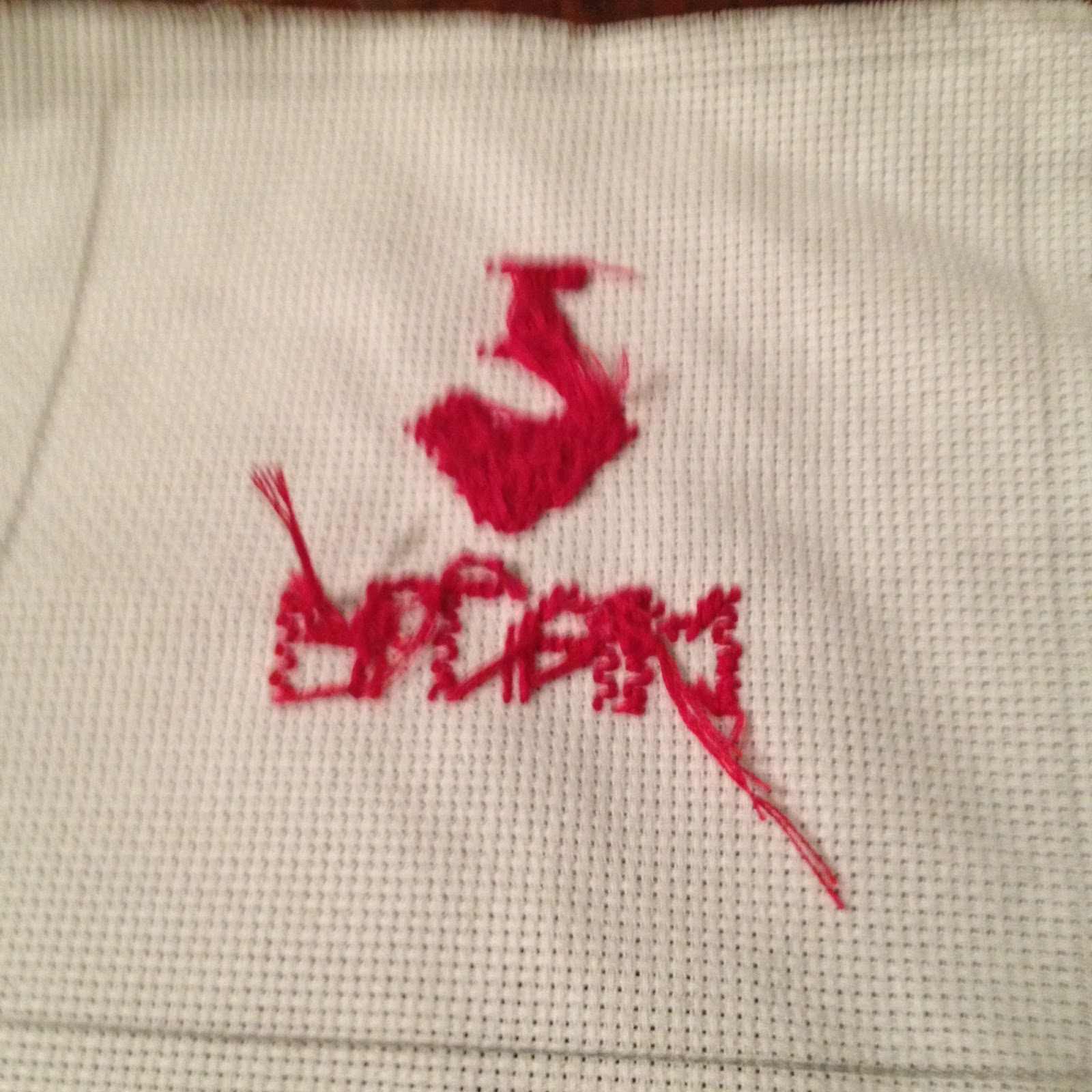
and as I trimmed it to fit into a square black frame, I said, "I feel like there's a metaphor here somewhere" but she laughed and ran off to play, already forgetting the many hours of messy and frustrating work it had taken, me by her side, to produce this valentine for her teacher.


In the spirit of a holiday that's supposedly all about love with a capital L, I love that she dreamed this project up herself and that she saw it through to completion. I love that - for the first time ever - she loves math, and that she loves the teacher who taught her to love it. I love that she could hardly wait to bring it to him on Valentine's Day. I love that her excitement stemmed from giving something she had made, something she was proud of, rather than from getting chocolate or treats (though she did, and she loved that too). If I'm being honest, I love that the project is finally done, for I could hardly step away for a stitch or two before she was calling my name. But mostly I love the way the beautiful finished product belies the messy backside full of ugly knots and missed stitches, the metaphor for life made piece by piece by my eight-year-old on a series of February days.

Friday, January 18, 2013
Apres
The morning hasn't been a great one, so far.
Jemma woke me up at 6:00 needing help with something potty-related; later, she refused to get dressed because she was "too tired to go to school" and "wanted Daddy to walk her to school" and "doesn't like gym, art and music," which she has today. Annie lost her mind because she ran out of time to finish dressing her doll before it was time to leave the house. (This is a child who, when I was explaining about my new DSLR camera and why I was taking a ton of pictures of the same object but just changing one setting on the camera to see what would happen, replied, "You mean like a variable?"; a child who is able to tell you Newton's law of gravity and theory of motion; yet is apparently also a child who believes that a doll is ALIVE and WILL BE COLD if someone doesn't put clothes on it ASAP.) Nobody could sit their butt down and eat breakfast. Somebody forgot her planner and lost her hat (AGAIN), and both children were in tears at some point.
Now I'm here, alone, with a yucky feeling in the pit of my stomach.
*****
Last weekend, we went skiing. It was the first time we'd attempted it as a family of four. A day before we left, I posted this as my Facebook status update:
Our status as we gear up for our first full-family ski trip: Annie, lost hat Tuesday; Jemma, lost mitten yesterday; weather forecast, 40s and rain; me, last seen on skis in 2002. So.
On Saturday morning, while Jason was in a continuing education class, the girls each had a ski lesson. I watched from my perch as they navigated the magic carpet on the bunny hill with their instructors, and then I picked them up and heard that they were "good to go" on the chair lift and the real hills.
We joined up with Jason, ate a quick lunch, and spent one million hours putting our ski gear back on. (SO. MUCH. GEAR.) (My gear, as you would expect, is also from 2002.) Then we hopped on the chairlift, all four of us in a row. It was sunny. We all had hats and mittens. We were ready to ski!
We got off at the top without incident, and Jason led us to the left. I was scanning the signs for a green run while trying to keep my eyes on the girls and while trying not to fall, so it's no surprise that I found myself just following Jason to a blue. We all did. And then we stared down what was a steeper hill than we had really meant to begin on.
"It'll be FINE," said my husband, ever the optimist. We started down. Jemma fell within the first ten yards and started to cry, while Annie zoomed ahead, going straight down the hill at top speed. I froze in the middle, not knowing what to do, then left Jason to help Jemma while I followed Annie. I tried to remember how to turn - turned right, turned left, zig-zagged my way down until somehow I was backwards for a split second before I fell spectacularly and lost my right ski. From my sitting position, I looked down the hill and spotted Annie, who had fallen and lost both her skis. I looked up at Jemma, who had fallen again and was refusing to get back up.
Thus began our first family ski trip.
*****
For some reason, this occurs to me this morning, as I'm standing in the kitchen unloading the dishwasher with a yucky feeling in the pit of my stomach and replaying the scenes from our chaotic morning. It's not possible, I know, to rewind our day and begin again, just as it wasn't possible to un-fall on that blue run last Saturday. I can't stop the falls, I can't stop the difficult moments. What I can control is what happens after - whether or not to get up, ski down to Annie, help her get her skis back on, and ski the rest of the way down laughing at ourselves. Whether or not to get Jemma back on the chair lift (after Jason skis down with her on his back) and find a nice green run that she handles just fine. Whether or not to make sure that an inauspicious start doesn't keep us from spending the three hours after enjoying the sunshine and snow with no falls and lots of smiles. Whether or not to let a not-great morning ruin the rest of the day, or to put yoga clothes on, move forward with the day, and plan to start again with the children when they get home from school. It's about what happens after.
(Apres skiing, by the way, we snuck away for a lovely grown-up dinner at a fancy French restaurant with good friends and plenty of red wine, so I think there might sometimes be a reward for getting through the hard stuff.)
Jemma woke me up at 6:00 needing help with something potty-related; later, she refused to get dressed because she was "too tired to go to school" and "wanted Daddy to walk her to school" and "doesn't like gym, art and music," which she has today. Annie lost her mind because she ran out of time to finish dressing her doll before it was time to leave the house. (This is a child who, when I was explaining about my new DSLR camera and why I was taking a ton of pictures of the same object but just changing one setting on the camera to see what would happen, replied, "You mean like a variable?"; a child who is able to tell you Newton's law of gravity and theory of motion; yet is apparently also a child who believes that a doll is ALIVE and WILL BE COLD if someone doesn't put clothes on it ASAP.) Nobody could sit their butt down and eat breakfast. Somebody forgot her planner and lost her hat (AGAIN), and both children were in tears at some point.
Now I'm here, alone, with a yucky feeling in the pit of my stomach.
*****
Last weekend, we went skiing. It was the first time we'd attempted it as a family of four. A day before we left, I posted this as my Facebook status update:
Our status as we gear up for our first full-family ski trip: Annie, lost hat Tuesday; Jemma, lost mitten yesterday; weather forecast, 40s and rain; me, last seen on skis in 2002. So.
On Saturday morning, while Jason was in a continuing education class, the girls each had a ski lesson. I watched from my perch as they navigated the magic carpet on the bunny hill with their instructors, and then I picked them up and heard that they were "good to go" on the chair lift and the real hills.
We joined up with Jason, ate a quick lunch, and spent one million hours putting our ski gear back on. (SO. MUCH. GEAR.) (My gear, as you would expect, is also from 2002.) Then we hopped on the chairlift, all four of us in a row. It was sunny. We all had hats and mittens. We were ready to ski!
We got off at the top without incident, and Jason led us to the left. I was scanning the signs for a green run while trying to keep my eyes on the girls and while trying not to fall, so it's no surprise that I found myself just following Jason to a blue. We all did. And then we stared down what was a steeper hill than we had really meant to begin on.
"It'll be FINE," said my husband, ever the optimist. We started down. Jemma fell within the first ten yards and started to cry, while Annie zoomed ahead, going straight down the hill at top speed. I froze in the middle, not knowing what to do, then left Jason to help Jemma while I followed Annie. I tried to remember how to turn - turned right, turned left, zig-zagged my way down until somehow I was backwards for a split second before I fell spectacularly and lost my right ski. From my sitting position, I looked down the hill and spotted Annie, who had fallen and lost both her skis. I looked up at Jemma, who had fallen again and was refusing to get back up.
Thus began our first family ski trip.
*****
For some reason, this occurs to me this morning, as I'm standing in the kitchen unloading the dishwasher with a yucky feeling in the pit of my stomach and replaying the scenes from our chaotic morning. It's not possible, I know, to rewind our day and begin again, just as it wasn't possible to un-fall on that blue run last Saturday. I can't stop the falls, I can't stop the difficult moments. What I can control is what happens after - whether or not to get up, ski down to Annie, help her get her skis back on, and ski the rest of the way down laughing at ourselves. Whether or not to get Jemma back on the chair lift (after Jason skis down with her on his back) and find a nice green run that she handles just fine. Whether or not to make sure that an inauspicious start doesn't keep us from spending the three hours after enjoying the sunshine and snow with no falls and lots of smiles. Whether or not to let a not-great morning ruin the rest of the day, or to put yoga clothes on, move forward with the day, and plan to start again with the children when they get home from school. It's about what happens after.
(Apres skiing, by the way, we snuck away for a lovely grown-up dinner at a fancy French restaurant with good friends and plenty of red wine, so I think there might sometimes be a reward for getting through the hard stuff.)
Wednesday, November 21, 2012
These Happy Golden Years
Annie's been working her way through the entire Little House series by Laura Ingalls Wilder, and right now she's in the middle of These Happy Golden Years. Some nights I read a few pages of it to her and then set her free for half an hour before lights-out (she's become a read-herself-to-sleep girl, like her mama), so I don't know or remember everything that's going on in the book, but I do love the title.
We've started watching the series sometimes, too: a special treat on a Sunday night after dinner is pudding, a fire, and an episode of Little House. It's become a bit of a tradition, though the episodes are not exactly they way I remember them. Some are a little, er, dicey - Jason and I will scroll through the DVR queue, reading the little descriptions, and wince: one titled "Injun Boy"; an episode about gambling and fighting over land in gold rush country; Mary defending the children from an attack of wolves or Pa coming to blows trying to get the country doctor to come to his illness-ravaged town. Compared to the silly, kid-sized "problems" that appear in most of the books and movies our kids are used to, these problems are not joking around. People die, families run out of food, kids get in real trouble for disobeying their parents, everyone has much less of everything.
It's tempting to read or watch the series, then, and think about the good old days and how different everything was. But, looking closer, I can see that some things are still the same as they ever were: golden-ringletted Nellie Olson is the town mean girl, some families have less than others, siblings bicker on their way to school and over doing their chores, and moms and dads have serious talks at the kitchen table after kids are tucked into bed for the night. Annie and Jemma, I can tell, are silently fascinated by the glimpse into "the olden days," with its outhouses and horses, wide-open fields and dusty towns, but their favorite parts are the parts they can relate to: Laura getting in trouble for reading a mystery at school, Carrie falling down adorably in the opening credits as she runs down a hill of tall grass.
A good friend gave me a card for my birthday, and I keep it on my desk. It says, "Those were the good old days - but so are these." Thanksgiving is tomorrow, and I've been trying to up my gratefulness quotient this year in particular ever since I stumbled on Ann Voskamp's One Thousand Gifts this spring. I've kept a gratitude journal (poorly, with limited success), and our family begins lots of meals together by each saying one thing we're grateful for at that moment. Annie's teacher this year has somehow done a bang-up job of teaching the kids that saying "it's not fair" is unacceptable, and Jemma brought home a plethora of Thanksgiving-related items in her folder yesterday. (Things she is thankful for: "My Hose (house), My FaMiLy, Grese (grass), THe CLooSe (clouds), GOD, and FEDS (friends).")
I'm often struck by a sense of nostalgia in the moment, by knowing in advance that I'm going to look back on these years and miss their innocence and goodness, and I feel like that when a folder full of construction-paper turkeys comes home and when our foursome is curled up on a Sunday night together watching Little House and eating homemade pudding. This Thanksgiving, I'm thankful for all the usual things - home, family, friendships, great teachers, good food, freedom, books, health - but mostly I'm thankful for the good old days: the ones when Laura and her family made their way on the prairie, the one when baby Annie fell asleep on the floor after Thanksgiving dinner and we left her there, covered with a blanket and walking around her until she woke up while I was eating pie; today, when my family eats oatmeal and pets kitties first thing in the morning, and the ones that will surely come in the future despite the changes that will inevitably come too.
"And that, to me, is the meaning of Thanksgiving . . . Nothing lasts; everything changes. People die, and marriages dissolve, and friendships fade, and families fall apart, whether or not we appreciate them; whether or not we give thanks every waking moment or one night a year. For the act of returning to the same table, to the same people and the same dishes - to the same traditions - can blind you to life's transience. It can lull you into believing that some things, at least, stay the same. And if that's what you believe, then what have you got to be grateful for? None of our Thanksgivings are ever coming back; we've lost them. They're gone. And so this year, let's go somewhere with strange customs and unfamiliar recipes and the latest collection of ill-assorted chairs, and give thanks - not for everything we have, but for everything, instead, that we have lost." - Michael Chabon, in November's Bon Appetit.
We've started watching the series sometimes, too: a special treat on a Sunday night after dinner is pudding, a fire, and an episode of Little House. It's become a bit of a tradition, though the episodes are not exactly they way I remember them. Some are a little, er, dicey - Jason and I will scroll through the DVR queue, reading the little descriptions, and wince: one titled "Injun Boy"; an episode about gambling and fighting over land in gold rush country; Mary defending the children from an attack of wolves or Pa coming to blows trying to get the country doctor to come to his illness-ravaged town. Compared to the silly, kid-sized "problems" that appear in most of the books and movies our kids are used to, these problems are not joking around. People die, families run out of food, kids get in real trouble for disobeying their parents, everyone has much less of everything.
It's tempting to read or watch the series, then, and think about the good old days and how different everything was. But, looking closer, I can see that some things are still the same as they ever were: golden-ringletted Nellie Olson is the town mean girl, some families have less than others, siblings bicker on their way to school and over doing their chores, and moms and dads have serious talks at the kitchen table after kids are tucked into bed for the night. Annie and Jemma, I can tell, are silently fascinated by the glimpse into "the olden days," with its outhouses and horses, wide-open fields and dusty towns, but their favorite parts are the parts they can relate to: Laura getting in trouble for reading a mystery at school, Carrie falling down adorably in the opening credits as she runs down a hill of tall grass.
A good friend gave me a card for my birthday, and I keep it on my desk. It says, "Those were the good old days - but so are these." Thanksgiving is tomorrow, and I've been trying to up my gratefulness quotient this year in particular ever since I stumbled on Ann Voskamp's One Thousand Gifts this spring. I've kept a gratitude journal (poorly, with limited success), and our family begins lots of meals together by each saying one thing we're grateful for at that moment. Annie's teacher this year has somehow done a bang-up job of teaching the kids that saying "it's not fair" is unacceptable, and Jemma brought home a plethora of Thanksgiving-related items in her folder yesterday. (Things she is thankful for: "My Hose (house), My FaMiLy, Grese (grass), THe CLooSe (clouds), GOD, and FEDS (friends).")
I'm often struck by a sense of nostalgia in the moment, by knowing in advance that I'm going to look back on these years and miss their innocence and goodness, and I feel like that when a folder full of construction-paper turkeys comes home and when our foursome is curled up on a Sunday night together watching Little House and eating homemade pudding. This Thanksgiving, I'm thankful for all the usual things - home, family, friendships, great teachers, good food, freedom, books, health - but mostly I'm thankful for the good old days: the ones when Laura and her family made their way on the prairie, the one when baby Annie fell asleep on the floor after Thanksgiving dinner and we left her there, covered with a blanket and walking around her until she woke up while I was eating pie; today, when my family eats oatmeal and pets kitties first thing in the morning, and the ones that will surely come in the future despite the changes that will inevitably come too.
"And that, to me, is the meaning of Thanksgiving . . . Nothing lasts; everything changes. People die, and marriages dissolve, and friendships fade, and families fall apart, whether or not we appreciate them; whether or not we give thanks every waking moment or one night a year. For the act of returning to the same table, to the same people and the same dishes - to the same traditions - can blind you to life's transience. It can lull you into believing that some things, at least, stay the same. And if that's what you believe, then what have you got to be grateful for? None of our Thanksgivings are ever coming back; we've lost them. They're gone. And so this year, let's go somewhere with strange customs and unfamiliar recipes and the latest collection of ill-assorted chairs, and give thanks - not for everything we have, but for everything, instead, that we have lost." - Michael Chabon, in November's Bon Appetit.
Monday, November 5, 2012
Don't Be a Jerk: A Manifesto on Sanity in Parenting and Politics on the Eve of an Election
Tomorrow’s presidential election will probably be the first
one my girls will remember. At ages eight and five, they notice the yard signs,
talk a little about the election at school, and ask my husband and me who we’ll
be voting for. Their curiosity has made for some great dinner-table
conversation at our house, and it’s made me realize that some of the
very same life rules I try to teach my girls are handy reminders for the best
ways to behave during an election year. I thought I said most of what I have to
say about politics in a post I wrote four years ago, but it turns out I wasn’t
finished.
I’ve noticed that these two subjects (parenting and
politics) have more in common than we might originally think. I’ve noticed that
most adults tend to fall into one of three camps when it comes to politics, and
I’ve deduced that, no matter which camp you’re in, we could all do with a
refresher course in how to deal with divisive issues – course material taken,
of course, from the very platitudes we spout to our children about compassion
and cooperation.
*
I’ll start by describing my husband’s approach to politics:
He doesn’t. Approach it, that is. He is the least-informed, least-partisan,
least-political person I know. We don’t watch the news at our house (don’t
watch much television at all, really, excepting a few regular sitcoms, Michigan
football, and (blushes) a relatively embarrassing amount of Tosh.O) and don’t
get the paper, either. He doesn’t
even spend much time on social media or talking with friends or neighbors about
current events, and our time together with our kids mostly involves listening
to music at top volume, cooking, being outside, or attending to the minutae of errands
and chores that it takes to run a household.
Ergo, things like the Aurora, Colorado shooting or the
Chick-Fil-A controversy happen, and he doesn’t even know unless I tell him.
(Which I usually think to do a couple days later, if at all.) He probably
didn’t notice when Romney picked Ryan for a running mate, and he’s never going
to discuss tax policy or healthcare reform with you at a cocktail party. Before
voting in the presidential election, he and I might have one or two conversations
where I lay out the major positions of both sides, and he’ll probably watch the
debates. That’s it.
I bet this approach looks irresponsible to a lot of people,
and I get how you could see it that way. After all, a democracy relies on an
informed electorate, and he’s not exactly informed. But you know what else he’s not? Bitter, obsessed, wrapped
up in issues beyond his control, or lying awake at night mentally responding to
an acrimonious Facebook debate. He chooses to use his energy running a
business, making a living for our family, raising his children the best he
knows how, playing music as much as possible, keeping his body healthy with
exercise, getting enough sleep, using television for occasional entertainment,
and surrounding himself with fun and positive people and experiences. He’s
scratched out his little corner of the world and he spends his days making that
little corner the best it can be. It’s thinking locally in the most literal way
possible.
On the other end of the spectrum, there is the approach to
politics I see modeled by plenty of other friends and family. Let’s call this
The Bubble Approach. It looks like this: No matter who is in office or what
issues are at hand, work yourself into a frenzy by watching the same, insular,
and biased news media on a daily basis. Bray loudly about how the world is this
close to going to hell in a handbasket. Be constantly full of rage and
contempt for “the other side.” See the world in black and white, and be
convinced that “they” are “evil.” Make every Facebook post about politics, use
divisive language, offend friends and loved ones with abandon, and spam
everyone on your email list with a constant stream of forwards and memes
designed to provoke alarm. Surround yourself with others who see the world
exactly the way you do, and make no attempt to allow other perspectives or
thoughtful dialogues into your circle. Most of all, don’t actually DO anything
to promote change, just stew about how horrible everything is, all of the time.
This approach, while tempting and probably even initially
satisfying (“I’m so right! Everyone I see on TV and know in real life agrees
with me!”), has some drawbacks, too. The first problem is that you go around in
a constant state of alarm, feeding off media-fed fear and certain that your
faithful group of citizens alone is the one last bulwark saving your country
from ruin. That’s a lot of pressure. I bet your blood pressure is a little
higher than average and you don’t always sleep that well at night. The second
problem with this approach is that you’re liable to offend friends and family
who love you, possibly without even knowing you’re doing it, leading to an even
greater loss of levity and balance in your world. You might not mind, but be
aware that you’re in danger of becoming that person next to whom nobody wants
to be seated at the family dinner for fear of what might come out of your
mouth. The lack of empathy and compassion you display isn’t winning you any new
friends, either – or, ironically, luring anyone over to your political
positions.
Then there’s a third approach. (Spoiler alert: I’m a sucker
for the third, moderate, just-right-bowl-of-porridge approach in almost every
situation!) The third approach to politics in an election year relies on remembering
the platitudes we constantly tell our children in an effort to turn them into
model little siblings and citizens (yes, I finally got back to that). I try (try!) to live in this third camp. Want to join me? Here’s
how that looks:
1. “Everyone is different, and likes different things.” This
is something I tell my children when they wonder why this little girl likes to
skateboard, or that little boy doesn’t know how to walk well yet, or this one
needs alone time while this one is a social butterfly, or this family watches a
show that we don’t, or this family spends their money on that, or this girl
gets her ears pierced, or that boy’s not allowed to play football.
Notice how I’m not judging the other kids or families,
because as long as there isn’t outright abuse or neglect, it’s totally
acceptable for people to do things differently – to have different priorities,
budgets, values, rules, and traditions. It’s the beauty of our country, right? But
the danger of both my husband’s “head-down” approach to politics as well as The
Bubble Approach is that you never see just how wide a swath of opinions,
lifestyles, and worldviews exist. Oh, you may think that you associate with a
wide variety of people or know a wide perspective, but you probably don’t.
For example, I know full well that, in the community I which
I live, our family is quite “average” in terms of income and wealth, but that
doesn’t mean that we are average in comparison with most people in the country.
In my upper-middle-class bubble, I see lots of people who think that they are
“regular, middle-class” people, but they aren’t. They’re overestimating how
much money most Americans make. Go ahead, Google “median family income” and see
how you stack up. I’ll wait. SEE?
More research that shows just how poorly we do at knowing
what is average or normal comes from Gretchen Rubin, author of The Happiness
Project. She writes on her blog, “Our sense of what’s “moderate” is also
affected by the psychological phenomenon of false consensus.
We tend to believe that other people agree with us, even when they don’t, and
to overestimate the commonness of our preferences and habits. Because we think
people are more like us than they are, we assume that what seems “moderate” to
us is objectively moderate.”
Rubin continues: “Also, because of “homophily,” which is the tendency of people to associate with
similar people, we tend to be friends with people who have the same sense of
how much drinking, or sugar, or exercise, or reading, is moderate or excessive.
So you do, in fact, see your tendencies reflected in the people around
you.”
By reminding ourselves - in the same way that we remind our
children - that “everyone is different,” we widen our sphere of influence and
let in a few more worldviews. Here’s why that’s important: Once you’ve recognized your bubbles and
become more aware of the wide range of legitimate worldviews, it’s tougher to
demonize the opposition. Once your best friend’s husband is an E.R. doctor who
does his best every day to provide good care to anyone who walks through the
hospital doors, you can’t lump all doctors in as “greedy.” Once you know
someone who has been racially discriminated against, you’ll have a different
perspective on affirmative action or hate speech. Once you know a gay
professional who grew up on welfare in a working-class town, put himself
through graduate school, and spends his vacations doing mission trips, you
realize that people don’t fit into tidy little boxes labeled “right” and
“wrong;” you remember that everyone is somebody’s beloved child; you notice
that every human being has the capacity for good and evil; and you make room
for a few more voices in your bubble.
2. “Is what
you’re saying kind and helpful?” This is the question I put to my daughters
when they criticize one another unnecessarily, when they jump in and add their
opinion when it wasn’t asked for, when they call names, when they use the words
“always” and “never,” and when they forget, as is the actual slogan at their
school, that “Kindness Counts!” If we don’t want our kids growing up to be
bullies, we shouldn’t be using our voices to bully our political opposition,
either. We should be asking ourselves, when we do engage in those passionate
conversations, whether what we’re saying is kind, and whether what we’re saying
is helpful to the conversation.
This is tricky, I know, because you want to spread The
Truth! You have it, and you just really, really need everyone else to know it.
You’re just educating people, you say. You’re not trying to be mean, per se,
but this piece of information is, as my eight-year-old would say, a True Fact,
and so, if in the telling, people’s feelings get hurt, oh well. The Truth must
be told!
First of all, congratulations on knowing The Truth! (Sarcasm
alert.) We should all be so lucky. Here’s a check against that impulse, though:
Would you let your daughter talk to her grandmother the way you’re talking to
your political opponent? Would you talk this way to your next-door neighbor, if
you knew you had to live next to him for the next twenty years? Would you
encourage your son to call his friend names to solve a problem?
I’m not saying you can never speak up for a cause you
believe in, or that people should always agree (or pretend to agree) with one
another. I value freedom of speech and expression mightily. But ask yourself if
you will be able to make your case for your opinion with kindness, civility,
and respect. If you won’t, it’s probably best not to engage. Just because you
CAN air your views on gun control, doesn’t mean you necessarily SHOULD.
Instead, if we truly want our children to engage the world
with kindness, we have to model that for them in our conversations. Vulnerability researcher Brene Brown,
in her article “The Cruelty Crisis: Bullying Isn’t a School Problem, It’s a
National Pastime,” writes:
“When it comes to managing conflict and difference, we're not exactly
modeling the behaviors that we want to see in our children. Whether it's
politics, religion, or social issues, the more uncertain we feel, the more
certain we act. Finger pointing, screaming, and in-your-face personal attacks
have replaced respectful and necessary debate and discourse. We see this
everywhere from political talk shows and school meetings, to the sidelines of
kids' soccer games. I've heard people define bullying as "angry,
aggressive acting out in children." I would argue that a lot of bullying
is simply kids acting like aggressive parents acting out and behaving like
angry children.”
If you want to survive the election season - or life in general, really - with your dignity and relationships
intact, you shouldn’t be bullying, name-calling, posting hateful screeds
online, spamming friends and family with email memes, or talking about the
other political party with hatred and contempt. You shouldn’t call candidates
“a big scary monster” or “a moronic weenie” (I’ve witnessed both this year);
you shouldn’t characterize an entire party as “all you liberal elites” or “those
conservative nuts;” and you should probably avoid the words “always” and
“never,” as they leave no room for real debate. In short, you shouldn’t be
talking to anyone about politics in a way that you wouldn’t allow your children
to speak to other human beings.
3. “You just
worry about you.” Ah, this one was a favorite of my mother’s when I was growing
up, and now it’s a favorite of mine. Nobody much likes the child who waits in
the wings to tattle on a sibling. Similarly, no grown voter appreciates your
unsolicited advice. (Also, the president is probably not going to call you for
your input about tax policy or abortion rights, so there is no need to have all
your platforms at the ready.) The world is not depending on you sending yet
another un-Snopes-researched email to everyone on your address list, and nobody
appreciates your loud and angry Facebook posts with constant links to partisan
sources. You don’t get to change anyone else’s mind or control anyone else’s
opinion. You just worry about YOU.
What does this look like? Well, for one, it might mean agreeing
to disagree with friends and family who are not on board with all your ideas.
It might further mean just not having those conversations any more, because
they cause too much angst and ill will. (How then, you wonder, will the people
around you learn The Truth? Well, if they want your opinion, here is how you
will know: They will ask you for it. (!) Otherwise, maybe stop talking about
it.)
I know this is hard, especially when you hear or see someone
stating an opinion with which you vehemently disagree. Just a week or two ago,
though, I saw two old friends battle bitterly over politics on Facebook, and I
couldn’t help but think that the damage it was doing to their relationship
wasn’t worth it. Certainly, neither of them changed their mind. Remember, please,
that we’re all going to have to wake up on November 7th and continue to live
with one another.
The second, more important part of worrying about yourself
means that you should be DOING SOMETHING PRODUCTIVE with your opinions. This is a happy resolution of the
extreme approaches to politics I talked about above. Think globally, then act
locally. Turn off Fox News (or MSNBC), stop listening to Michael Moore’s (or
Rush Limbaugh’s) rude diatribes, delete the propaganda-filled email, ignore the
YouTube videos, and try to change your little, local corner of the world for
the better. So if you are passionate about the right to life for the unborn,
find a local organization that needs your help and spend your time counseling
pregnant mothers, donating clothing and diapers to a shelter, or advocating at
an adoption agency. If you have strong convictions about the environment, give
your money to the Sierra Club or a local watershed clean-up effort. If you feel
strongly about education, volunteer in a school to help students learn to read,
and write a check to your local PTA. Knock on doors for local candidates you
believe in (I’ve done this, and it’s actually fun), find a local organization
doing something positive to support with your time, energy, and money, and, of
course, vote. You get one vote. We all do. But all of your strong convictions
are so much empty air unless you act on them, and act on them 365 days a year,
not just in the frenzy of a major election year.
Tomorrow, millions of Americans will go stand in line to
vote for the next President of the United States. Later tomorrow, those same
Americans will sit around family dinner tables or meet friends for drinks to
watch those election results come in. No matter who you vote for – no matter
who wins – if you truly want the next generation of Americans to be
compassionate citizens of a productive country, try to remember that the very
platitudes we use to teach our children kindness, respect, and responsibility
are good reminders for their voting-aged parents, too. Consider expanding your
bubble, talking with kindness, and worrying about yourself. Consider taking a
moderate approach to politics, and, please, don’t be a jerk. The parent AND the
voter in me thanks you in advance.
Tuesday, September 4, 2012
Unbroken
The girls are at school.
I woke up this morning at 5:20 a.m. thanks to a loud clap of thunder, so I got up, made the coffee, and sat drinking it in the dark. I thought about how, eight years ago, I was exactly one week away from giving birth to Annie. It's the day that feels like the beginning of my experience as a mother, and this day feels like an end. Not THE end, just AN end - to being at home with my girls, to being needed that way, to knowing that my primary job is raising them, feeding them, playing with them, keeping them safe. I could have cried a little this morning, sitting there in the dark, but I didn't, because I knew that if I started it'd be hard to stop, and because I didn't want to let them see me sad on their big first days.
I got them up, fed them breakfast, helped them pack their lunches into their backpacks and put headbands in their hair, took their pictures on the front step, and walked them to school in the rain. Annie was uncertain, a little excited and a little nervous. Jemma was ready, confident, happy. I hugged and kissed Annie when she turned to walk to her 3rd grade line, took Jemma to her door for a final kiss and hug, and then I walked home by myself, swinging my umbrella because the rain had stopped.
Now I am here. It's what I've thought I wanted for years. Time to myself, a little peace and quiet (or "a piece of quiet," as I used to call it when I was small), space to write and think and organize. And I DO want it. It's just a little scary. A little abrupt. Two weeks ago, our family was on a ten-day vacation, every day packed with sunshine and swimming and hiking and constant togetherness. Today, it's silent but for the hum of the dryer and the clicking of my keyboard.
What will I do? Oh, I have a list. There are projects I've been putting off all summer (organizing Jemma's old bedroom into a bona fide office, cleaning out closets, getting back to a regular yoga practice) and projects I've been putting off for eight years (acquiring and filling a fireproof safe, painting the walls in the stairway that have been scuffed since the day we moved in, writing something cohesive and meaningful).
What will I do? Maybe I'll rejoin Netflix just so I can watch the entirety of Friday Night Lights. Maybe I'll read a book a day, run every morning, take a post-lunch nap every afternoon. Maybe I'll get a job. (I almost got one last winter, though I didn't write about it here.) I hope I figure out how to fill every day with a mix of meaningful activities, figure out how to keep doing things that matter, figure out how to stretch myself and try new, hard things.
*****
I read the book Unbroken by Laura Hillenbrand earlier this year and, later, was discussing it with a family member who had also read it.
"What did you think?" I asked.
"I thought it really showed how much evil there is in the world, how evil people can be to one another," he said. "What did you think?"
"I thought it was about how incredibly resilient the human spirit can be in spite of unthinkable difficulty," I said.
Hmm.
I still like my answer, but I want to change it. Unbroken was about potential. It was about how every person possesses the potential to act for good or for evil. Both the hero in that story and the villain had one life on this earth, and their stories were a sum of their choices.
I think that's what this time in my life is about, too. Potential. Wide open. One choice at a time.
I woke up this morning at 5:20 a.m. thanks to a loud clap of thunder, so I got up, made the coffee, and sat drinking it in the dark. I thought about how, eight years ago, I was exactly one week away from giving birth to Annie. It's the day that feels like the beginning of my experience as a mother, and this day feels like an end. Not THE end, just AN end - to being at home with my girls, to being needed that way, to knowing that my primary job is raising them, feeding them, playing with them, keeping them safe. I could have cried a little this morning, sitting there in the dark, but I didn't, because I knew that if I started it'd be hard to stop, and because I didn't want to let them see me sad on their big first days.
I got them up, fed them breakfast, helped them pack their lunches into their backpacks and put headbands in their hair, took their pictures on the front step, and walked them to school in the rain. Annie was uncertain, a little excited and a little nervous. Jemma was ready, confident, happy. I hugged and kissed Annie when she turned to walk to her 3rd grade line, took Jemma to her door for a final kiss and hug, and then I walked home by myself, swinging my umbrella because the rain had stopped.
Now I am here. It's what I've thought I wanted for years. Time to myself, a little peace and quiet (or "a piece of quiet," as I used to call it when I was small), space to write and think and organize. And I DO want it. It's just a little scary. A little abrupt. Two weeks ago, our family was on a ten-day vacation, every day packed with sunshine and swimming and hiking and constant togetherness. Today, it's silent but for the hum of the dryer and the clicking of my keyboard.
What will I do? Oh, I have a list. There are projects I've been putting off all summer (organizing Jemma's old bedroom into a bona fide office, cleaning out closets, getting back to a regular yoga practice) and projects I've been putting off for eight years (acquiring and filling a fireproof safe, painting the walls in the stairway that have been scuffed since the day we moved in, writing something cohesive and meaningful).
What will I do? Maybe I'll rejoin Netflix just so I can watch the entirety of Friday Night Lights. Maybe I'll read a book a day, run every morning, take a post-lunch nap every afternoon. Maybe I'll get a job. (I almost got one last winter, though I didn't write about it here.) I hope I figure out how to fill every day with a mix of meaningful activities, figure out how to keep doing things that matter, figure out how to stretch myself and try new, hard things.
*****
I read the book Unbroken by Laura Hillenbrand earlier this year and, later, was discussing it with a family member who had also read it.
"What did you think?" I asked.
"I thought it really showed how much evil there is in the world, how evil people can be to one another," he said. "What did you think?"
"I thought it was about how incredibly resilient the human spirit can be in spite of unthinkable difficulty," I said.
Hmm.
I still like my answer, but I want to change it. Unbroken was about potential. It was about how every person possesses the potential to act for good or for evil. Both the hero in that story and the villain had one life on this earth, and their stories were a sum of their choices.
I think that's what this time in my life is about, too. Potential. Wide open. One choice at a time.
Thursday, July 12, 2012
Under Pressure
It seems like half the conversations I've had lately center around children's schedules and extra-curricular activities, specifically the sports they'll be doing come fall. Now, it's only mid-July, so I don't yet want to think or talk about our fall schedule, but there are decisions to be made. Child X's parents gave me a card at the playground the week school got out for the club soccer team that involves tryouts, twice-weekly practice, and Saturday games that require travel. The dance studio sent me the girls' end-of-year "progress reports"and wants their registration, with $50 deposit, by August 1. Child Y's mom texts me to ask what I'm putting Jemma in this fall (a fall that will include full-day kindergarten, by the way, and probably the accompanying meltdowns and 5:30 p.m. weeping that I enjoyed when Annie began full-day school) and I tell her, guiltily, "probably nothing." This week's tennis instructor talks up the fall tennis clinic at the gym. Annie turns a billion cartwheels in the lawn and nags me every day to sign her up for gymnastics. Church wants Sunday School forms returned. Piano lessons continue unabated through the summer. And the Parks and Recreation fall brochure hasn't even come out, with its pages and pages of yoga! and swim lessons! and drawing!
And even as I participate in it, it drives me crazy. Here's why.
Last fall, Annie - who had been enrolled almost continuously in dance classes since the minute she turned three - decided she wanted to take a break from dance and try tennis instead. Fine. So I signed just Jemma up for dance on Thursday afternoons, and Annie and I used the forty-five minutes outside Jemma's class to work on homework projects, enjoy a snack together, and read aloud if there was time. It was a nice break, and at the end of it, Annie decided she wanted to take dance again beginning in January.
Because none of the classes offered for that semester at our parks and rec. department worked with our schedule and because I had decided that, if Annie was to continue dance, she should probably start going to a studio, we signed up at a new place. The instructor - a very nice person, obviously, with lots of talent and experience - had the girls come try out a class before letting us sign up. Jemma was immediately put into the age-appropriate class. After watching Annie (who, remember had taken several continuous semesters of dance but hadn't danced since the previous spring because of a summer off and not enrolling in the fall), the instructor recommended that Annie take a few private lessons before starting in the 7-year-old class. She was behind.
That's when I knew. And even though Annie took two private lessons, subsequently enrolled with her "cohort," and enjoyed the spring semester of dance with the talented instructor at her studio, I learned the lesson that every parent attempting to retain a semblance of a normal childhood learns. I learned that we must constantly keep up with an activity or else we risk being left behind completely. Worse, I realized that this is the case with every single activity that kids participate in, and it begins at least by age seven, when the pressure begins to change from participating in lots of things all the time, to the pressure to specialize in AND BE AWESOME at something.
Already, that dance instructor wants Annie to audition for the studio's ensemble, which would require her to dance two afternoons and one Saturday morning per week. Already, the local parks and rec. soccer is badmouthed by parents in the know, and we're encouraged to sign her up for something more organized and ambitious. Already, there are children in her tennis class who have clearly taken tennis every week of this summer and who are worlds better than her. Already, a parent talks about how frustrated her son is to be on a baseball team with kids who are "just trying baseball for the first time" and how kids like him (the good kids) get singled out for the All-Star team, where they can really play without the newbies dragging them down. (This same parent talks about how her "entire life is for the kids" these days; these two topics seem to me to be related.) Already, Annie has friends who are in year three of competitive swimming, so that each year that Annie does not swim on a team that practices three days a week and competes in meets is another year that the possibility of her EVER being able to swim on a team like that grows smaller. Already, there are not enough days in the week for Annie to keep up with the things she enjoys, not to mention to try new things that she hasn't yet dabbled in. Already, there is very much the feeling that she must PICK SOMETHING NOW and STICK WITH IT FOREVER and have it be HER THING, and that if she doesn't - if she keeps trying to dabble here, enjoy there, try this, take a break, take up something new - she will not be good enough at anything. (Also: "good enough" to . . . what? Make the middle school team? Play varsity tennis? Get a soccer scholarship to college? MAKE AN OLYMPIC TEAM?) WHAT IS THE GOAL HERE?
Are those kids going to be happier? More successful? The most in-shape adults? What? (Tangent: Most adults I know who took this path - crazy travel soccer, psycho swimmer, college athlete, etc. - don't even participate in the activity as an adult. At all. Ever. Huh.)
She is seven. SEVEN. She enjoys - and is fairly good at - lots of things. And I want her to be able to keep doing them: because she loves them, because she is good at them, because it is good for her to grow her skills, because I want her to be well-rounded, because they are fun. But it's clear that we're reaching a level where there aren't enough days in the week, where it's less possible to do things in a casual, low-committment way, where the cost and scale and intensity of each individual activity goes up, where she (and we) are going to have to choose. And I wish that I could put that off for a few more years. I wish, like a funny and wise friend said a few months ago, that we could all collectively just agree to not do this with our kids. I wish that I could remember that Jason, who is playing electric guitar on stage next week, didn't start taking guitar lessons until he was in college, and that I hated track in high school but went on to run a marathon at age 26 and my fastest 5K ever nine months after Annie was born. I wish I was surrounded by a few more sane voices shouting for moderation. Mostly, I wish I could figure out a way to let my girls pursue their passions with alittle lot less pressure.
And even as I participate in it, it drives me crazy. Here's why.
Last fall, Annie - who had been enrolled almost continuously in dance classes since the minute she turned three - decided she wanted to take a break from dance and try tennis instead. Fine. So I signed just Jemma up for dance on Thursday afternoons, and Annie and I used the forty-five minutes outside Jemma's class to work on homework projects, enjoy a snack together, and read aloud if there was time. It was a nice break, and at the end of it, Annie decided she wanted to take dance again beginning in January.
Because none of the classes offered for that semester at our parks and rec. department worked with our schedule and because I had decided that, if Annie was to continue dance, she should probably start going to a studio, we signed up at a new place. The instructor - a very nice person, obviously, with lots of talent and experience - had the girls come try out a class before letting us sign up. Jemma was immediately put into the age-appropriate class. After watching Annie (who, remember had taken several continuous semesters of dance but hadn't danced since the previous spring because of a summer off and not enrolling in the fall), the instructor recommended that Annie take a few private lessons before starting in the 7-year-old class. She was behind.
That's when I knew. And even though Annie took two private lessons, subsequently enrolled with her "cohort," and enjoyed the spring semester of dance with the talented instructor at her studio, I learned the lesson that every parent attempting to retain a semblance of a normal childhood learns. I learned that we must constantly keep up with an activity or else we risk being left behind completely. Worse, I realized that this is the case with every single activity that kids participate in, and it begins at least by age seven, when the pressure begins to change from participating in lots of things all the time, to the pressure to specialize in AND BE AWESOME at something.
Already, that dance instructor wants Annie to audition for the studio's ensemble, which would require her to dance two afternoons and one Saturday morning per week. Already, the local parks and rec. soccer is badmouthed by parents in the know, and we're encouraged to sign her up for something more organized and ambitious. Already, there are children in her tennis class who have clearly taken tennis every week of this summer and who are worlds better than her. Already, a parent talks about how frustrated her son is to be on a baseball team with kids who are "just trying baseball for the first time" and how kids like him (the good kids) get singled out for the All-Star team, where they can really play without the newbies dragging them down. (This same parent talks about how her "entire life is for the kids" these days; these two topics seem to me to be related.) Already, Annie has friends who are in year three of competitive swimming, so that each year that Annie does not swim on a team that practices three days a week and competes in meets is another year that the possibility of her EVER being able to swim on a team like that grows smaller. Already, there are not enough days in the week for Annie to keep up with the things she enjoys, not to mention to try new things that she hasn't yet dabbled in. Already, there is very much the feeling that she must PICK SOMETHING NOW and STICK WITH IT FOREVER and have it be HER THING, and that if she doesn't - if she keeps trying to dabble here, enjoy there, try this, take a break, take up something new - she will not be good enough at anything. (Also: "good enough" to . . . what? Make the middle school team? Play varsity tennis? Get a soccer scholarship to college? MAKE AN OLYMPIC TEAM?) WHAT IS THE GOAL HERE?
Are those kids going to be happier? More successful? The most in-shape adults? What? (Tangent: Most adults I know who took this path - crazy travel soccer, psycho swimmer, college athlete, etc. - don't even participate in the activity as an adult. At all. Ever. Huh.)
She is seven. SEVEN. She enjoys - and is fairly good at - lots of things. And I want her to be able to keep doing them: because she loves them, because she is good at them, because it is good for her to grow her skills, because I want her to be well-rounded, because they are fun. But it's clear that we're reaching a level where there aren't enough days in the week, where it's less possible to do things in a casual, low-committment way, where the cost and scale and intensity of each individual activity goes up, where she (and we) are going to have to choose. And I wish that I could put that off for a few more years. I wish, like a funny and wise friend said a few months ago, that we could all collectively just agree to not do this with our kids. I wish that I could remember that Jason, who is playing electric guitar on stage next week, didn't start taking guitar lessons until he was in college, and that I hated track in high school but went on to run a marathon at age 26 and my fastest 5K ever nine months after Annie was born. I wish I was surrounded by a few more sane voices shouting for moderation. Mostly, I wish I could figure out a way to let my girls pursue their passions with a
Wednesday, May 2, 2012
On Teaching and Parenting
I had a conversation this morning with a friend about teaching (our school district is trying to come up with the funds to continue having paraprofessionals in the kindergarten and first grade classrooms, which I think is essential) and then I went to yoga at noon, where two different teachers shared teaching the class. So while I was lying on my back at the end of class, I was thinking about the way that good teaching is both an art and a science, and about how I continue to be surprised that I am not a better parent, because I was a very good teacher. And isn't parenting just teaching on a much smaller, much more continuous scale?
Don't get me wrong, I had a few extra-specially difficult kids in classrooms over the years, but even then I never became completely unwound by the difficulties. I put in my very best effort and knew, somehow, that my very best effort would have to be enough, that there was nothing more I could do. Maybe in parenting, we're too close to the source, too constantly surrounded by the "pupils," and too attached to the outcome to be as level-headed. In any case, I never yelled. I never lost my temper. I never went into another room to cry or lay awake at night going over where it had all gone so wrong.
This is not to say that parenting the girls lately has been completely joyless. In every day there are moments of satisfaction and goodness, and I try to focus on those. I try to take the long view, to have some perspective that things will not always be this way. (Swistle, again, putting my thoughts into words.)
When that fails, there is always commiserating with girlfriends, running, drinking, getting out of the house, or going to sleep and pinning my hopes on the fact that the morning will bring a clean slate and a fresh start. But it hasn't really been a party for me lately, and I'm wishing I could channel a bit of Wise Teacher Stephanie to tell Frazzled Parent Stephanie what to do.
Back to lying on my back after yoga: I'm thinking about teaching. I'm thinking that I used to love teaching the same units and skills and information to new students every year, the way I did at Cranbrook, because the fresh crop of students every year ensures that the experience is different. I'm thinking, too, that there's probably satisfaction in teaching new skills and information to the same students, the way my instructor does at the yoga studio, because the continuity of learners lets you see people progress in their practice.
So:
Parenting. Especially the kind of parenting I'm largely doing these days, the kind where you keep saying the words, modeling the behavior, providing the information, encouraging the skills, and yet it's a Groundhog's Day situation of the same frustrations happening again and again.
Maybe I need to switch up my material. It's either that or switch up the kids, I guess.
Don't get me wrong, I had a few extra-specially difficult kids in classrooms over the years, but even then I never became completely unwound by the difficulties. I put in my very best effort and knew, somehow, that my very best effort would have to be enough, that there was nothing more I could do. Maybe in parenting, we're too close to the source, too constantly surrounded by the "pupils," and too attached to the outcome to be as level-headed. In any case, I never yelled. I never lost my temper. I never went into another room to cry or lay awake at night going over where it had all gone so wrong.
This is not to say that parenting the girls lately has been completely joyless. In every day there are moments of satisfaction and goodness, and I try to focus on those. I try to take the long view, to have some perspective that things will not always be this way. (Swistle, again, putting my thoughts into words.)
When that fails, there is always commiserating with girlfriends, running, drinking, getting out of the house, or going to sleep and pinning my hopes on the fact that the morning will bring a clean slate and a fresh start. But it hasn't really been a party for me lately, and I'm wishing I could channel a bit of Wise Teacher Stephanie to tell Frazzled Parent Stephanie what to do.
Back to lying on my back after yoga: I'm thinking about teaching. I'm thinking that I used to love teaching the same units and skills and information to new students every year, the way I did at Cranbrook, because the fresh crop of students every year ensures that the experience is different. I'm thinking, too, that there's probably satisfaction in teaching new skills and information to the same students, the way my instructor does at the yoga studio, because the continuity of learners lets you see people progress in their practice.
So:
same information + new students = fun, satisfying teaching experienceand
new information + same students = fun, satisfying teaching experiencebut you know what sucks?
same information + same students = unsatisfying, frustrating teaching experienceAnd what situation most closely mirrors that?
Parenting. Especially the kind of parenting I'm largely doing these days, the kind where you keep saying the words, modeling the behavior, providing the information, encouraging the skills, and yet it's a Groundhog's Day situation of the same frustrations happening again and again.
Maybe I need to switch up my material. It's either that or switch up the kids, I guess.
Monday, April 30, 2012
Read Elsewhere: Books, Human Nature, Weight, Appearances
"I think, consciously or not, what we readers do each time we open a book is to set off on a search for authenticity. We want to get closer to the heart of things, and sometimes even a few good sentences contained in an otherwise unexceptional book can crystallize vague feelings, fleeting physical sensations, or, sometimes, profound epiphanies." - Maureen Corrigan, Leave me Alone, I'm Reading
"Most Asian cultures see human beings as innately good, born perfect but then pulled off course by false beliefs, unfounded fears, and other delusions. The Judeo-Christian tradition that undergirds Western philosophy sees humans as innately imperfect, born with all sorts of problems (original sin, carnal nature, ignorance of God's laws) that must be rectified and controlled if we are to become worthy. From a Western perspective, setting the original self free is shocking and dangerous: 'Why, if we just act from a place of freedom, we'll all be pillaging and looting by nightfall.' In Asian psychology, pillaging and looting (etc., etc.) come from a place of delusion, from imagining ourselves as separate from others, so that our welfare and theirs are disconnected." - Martha Beck, Steering by Starlight
"None of us lead the lives our appearance suggests. We each lie in bed at night with our personal terrors as to what life could be, or about what life is like right now, and whether we have the strength to get through it. Clothes and money rarely can make that go away." - Deborah L. Jacobs, in Forbes Magazine
"Most Asian cultures see human beings as innately good, born perfect but then pulled off course by false beliefs, unfounded fears, and other delusions. The Judeo-Christian tradition that undergirds Western philosophy sees humans as innately imperfect, born with all sorts of problems (original sin, carnal nature, ignorance of God's laws) that must be rectified and controlled if we are to become worthy. From a Western perspective, setting the original self free is shocking and dangerous: 'Why, if we just act from a place of freedom, we'll all be pillaging and looting by nightfall.' In Asian psychology, pillaging and looting (etc., etc.) come from a place of delusion, from imagining ourselves as separate from others, so that our welfare and theirs are disconnected." - Martha Beck, Steering by Starlight
"Nevertheless, she is six years old, and she is so far below the average weight for her height that the pediatrician mentions it at each visit, and she doesn't want to gain weight. She's mentioned this a few times recently, but I've ignored it because I didn't want to draw a lot of attention to it---or more truthfully, because I didn't know what to say. This time I asked soooooo casually if the other girls at school talk about gaining weight. She said no. I asked if anyone else had mentioned it. She said no. I asked why she said she didn't want to gain weight, and she laughed nervously and said, well, she meant she didn't want to gain TOO MUCH weight.
I didn't pursue it any further. There isn't any point. It's not as if it's possible to rear a daughter who doesn't understand that this society expects her to be thin. I'd been hoping, though, for a longer time before she understood it." - Swistle, writing "Weight and Daughters" at the blog Swistle
I didn't pursue it any further. There isn't any point. It's not as if it's possible to rear a daughter who doesn't understand that this society expects her to be thin. I'd been hoping, though, for a longer time before she understood it." - Swistle, writing "Weight and Daughters" at the blog Swistle
Thursday, April 5, 2012
On the Turning Away
My whole life, my mom has said the same thing to me each time I turn to leave. As I get in the car, walk out the door, hop out of the mini-van, pull out of the driveway, she says, "Be careful!" She said it yesterday - yesterday! - as I, a 34-year-old woman with two children in my backseat, a person who has never been involved in any kind of car accident and pretty much never speeds, backed down her driveway.
She does it, I know, out of love. She doesn't want anything bad to happen to me, as as a mom now myself, I very much get that. I haven't started saying it to my own children, though. I think it sends a message that I would rather not send; that is, the world is a scary and dangerous place, so above all, your number one priority should be being careful. In fact, I've worked very hard in the last few months to send the very opposite message to a pretty anxious little girl. The message I want to send is, embrace this good day, for while bad things are possible, they are not likely, and you will prevail! So I say, "Do your best!" and "Have a great day!" and "Have fun!" as I kiss her good-bye and she turns away to walk into school. I liked my message better.
And then I read this passage in How to Talk So Kids Will Listen and Listen So Kids Will Talk this morning:
It stopped me dead in my tracks, for it reminded me immediately of the infamous "Don't Carpe Diem" blog post that went viral among mommy-bloggers and Facebook users everywhere a couple months ago. Here's the gist:
I realized that I'm not really sending a better message with my flung-from-the-doorway words of wisdom than my mom does. I realized that, after three little old ladies told me in the span of two days in Florida to "enjoy every moment!" I should know better than to expect that every day Annie has at school will be "great!" or that every play date Jemma goes to will be "super-fun!" I realized that I'm acting like the older lady in the grocery store!!
I'm not going to start telling them to be careful. But I am going to stop telling them to (and asking them later if they did) have fun. I think I'll start trying to say, simply, I love you.
She does it, I know, out of love. She doesn't want anything bad to happen to me, as as a mom now myself, I very much get that. I haven't started saying it to my own children, though. I think it sends a message that I would rather not send; that is, the world is a scary and dangerous place, so above all, your number one priority should be being careful. In fact, I've worked very hard in the last few months to send the very opposite message to a pretty anxious little girl. The message I want to send is, embrace this good day, for while bad things are possible, they are not likely, and you will prevail! So I say, "Do your best!" and "Have a great day!" and "Have fun!" as I kiss her good-bye and she turns away to walk into school. I liked my message better.
And then I read this passage in How to Talk So Kids Will Listen and Listen So Kids Will Talk this morning:
"One common parental inquiry that seems to be experienced as pressure is "Did you have fun today?" What a demand to make upon a child! Not only did he have to go to the party (school, play, camp, dance) but the expectation is that he should enjoy himself. If he didn't, he has his own disappointment to cope with plus that of his parents. He feels he's let them down by not having a good time."
It stopped me dead in my tracks, for it reminded me immediately of the infamous "Don't Carpe Diem" blog post that went viral among mommy-bloggers and Facebook users everywhere a couple months ago. Here's the gist:
Every time I'm out with my kids -- this seems to happen:An older woman stops us, puts her hand over her heart and says something like, "Oh, Enjoy every moment. This time goes by so fast."Everywhere I go, someone is telling me to seize the moment, raise my awareness, be happy, enjoy everysecond, etc, etc, etc.I know that this message is right and good. But, I have finally allowed myself to admit that it just doesn't work for me. It bugs me. This CARPE DIEM message makes me paranoid and panicky. Especially during this phase of my life - while I'm raising young kids. Being told, in a million different ways to CARPE DIEM makes me worry that if I'm not in a constant state of intense gratitude and ecstasy, I'm doing something wrong.I think parenting young children (and old ones, I've heard) is a little like climbing Mount Everest. Brave, adventurous souls try it because they've heard there's magic in the climb. They try because they believe that finishing, or even attempting the climb are impressive accomplishments. They try because during the climb, if they allow themselves to pause and lift their eyes and minds from the pain and drudgery, the views are breathtaking. They try because even though it hurts and it's hard, there are moments that make it worth the hard. These moments are so intense and unique that many people who reach the top start planning, almost immediately, to climb again. Even though any climber will tell you that most of the climb is treacherous, exhausting, killer. That they literally cried most of the way up.And so I think that if there were people stationed, say, every thirty feet along Mount Everest yelling to the climbers -- "ARE YOU ENJOYING YOURSELF!? IF NOT, YOU SHOULD BE! ONE DAY YOU'LL BE SORRY YOU DIDN'T!" TRUST US!! IT'LL BE OVER TOO SOON! CARPE DIEM!" -- those well-meaning, nostalgic cheerleaders might be physically thrown from the mountain.
I realized that I'm not really sending a better message with my flung-from-the-doorway words of wisdom than my mom does. I realized that, after three little old ladies told me in the span of two days in Florida to "enjoy every moment!" I should know better than to expect that every day Annie has at school will be "great!" or that every play date Jemma goes to will be "super-fun!" I realized that I'm acting like the older lady in the grocery store!!
I'm not going to start telling them to be careful. But I am going to stop telling them to (and asking them later if they did) have fun. I think I'll start trying to say, simply, I love you.
Tuesday, March 27, 2012
That's Me in the Corner; That's Me in the Spotlight
The crux of the problem is this: they don't ever sing the song “Jesus Loves Me.”
Annie entered first grade last year, and so along with all-day school and actual nightly homework at our neighborhood public school, she also became eligible to attend weekly catechism at the Catholic church our family attends. According to the schedule at our church, after she attends the Monday night sessions for two years, she’ll make her first communion toward the end of second grade . . . and receive the sacrament of reconciliation at the end of fourth grade, and be confirmed at the end of eighth grade. Sitting in the church basement with the other parents on the first night, holding that schedule in my hands, I got nervous. Suddenly, it seemed we were signing our six-year-old up for years and years of instruction, and I didn’t know if I liked where it was going.
For Jason, who grew up Catholic, it was a no-brainer. He’s the kind of person who keeps a Bible on the nightstand on his side of the bed, the kind of person whose Catholicism is buoyed by years of Catholic school and by an extended family that makes pilgrimages to shrines in honor of the Virgin Mary and has the priest over for dinner regularly.
For me, it’s a bit more complicated. I’m the kind of person who used to keep a Bible on the nightstand on my side of the bed back when I went on mission trips with my high school youth group and taught Sunday School to the little kids at my church. My faith was buoyed by going to a small, Christian liberal arts college and by an extended family who had been elders and deacons for generations in the Protestant tradition in which I was raised.
I came to the Catholic church later in life, after I met and married Jason, and it was around this time that my faith started to sink. Oh, I was fortunate enough to go through the RCIA process at a vibrant, progressive student parish in a university town, and my family was never anything but supportive of this turn in my faith journey. I become Catholic because I wanted our future family to share a tradition and because it was more important to Jason than it was to me that we worship in a particular way. But for me, there was always confusion and even outright disagreement about things like indulgences, purgatory, social issues, and Mary. I wasn't thrilled to be welcomed into the Catholic church during the same year that the priest abuse scandal hit the news, either. I found things I appreciated – the quiet prayer after eucharist, the passing of the peace, the emphasis on social justice and compassion for the voiceless in our society – but I also saw things I didn’t understand, things that seemed (not to put too fine a point on it) a little crazy.
For example, Jason and I put our house on the market about a year after Annie was born. My in-laws came to babysit for a weekend just as the sign was going in the yard so my husband and I could go to his college roommate's wedding. While we were gone and without telling us, my in-laws secretly buried a statue of St. Joseph upside down in our yard in some sort of Catholic voodoo belief that the statue would help our house to sell. When I found out weeks later that there was an upside-down statue of a saint somewhere in my yard, I was fairly annoyed. I may have actually dug around under our front hedges with a trowel, trying unsuccessfully to locate the statue.
“That is not how God works!” I informed my husband.
“Well, how does God work, then?” he asked.
“I don’t know,” I answered, “but not that way.” (The house took five years to sell.)
Other things rankled. I sat through more than one homily that used fear and guilt to strongly suggest that anyone not in full compliance with every tenet of the church was Doing It Wrong. I saw people putting an awful lot of effort into praying certain prayers in a certain order on certain days, believing in a magical formula for staying out of hell, putting all the emphasis on procedure without any nod to the meaning behind it. I read bulletin articles that barely disguised their contempt for gay people, for other Christian traditions, for certain political parties, for anyone who questioned things that seemed a little off. More often than not, I felt harangued, badgered, scolded, disheartened when I left church. I did not feel loved, empowered, valued, surrounded by grace.
I had become a reluctant Catholic, and I stopped keeping a Bible on my nightstand. I focused instead on the tangible things I could do to be a positive part of a church community. We gave a percentage of our income to the weekly offering. I signed up to bring meals to homebound parishioners. Later, after we had finally moved, I volunteered in Annie’s (and, eventually, Jemma's) Sunday School class, where they made crafts and learned to make the sign of the cross but did not, I noticed, ever hear the sweet little Bible stories of my youth or sing the song Jesus Loves Me. The lack of this song – the very core of the idea I believed a church should be teaching its children – bothered me, but I said nothing. I stopped thinking about things too much.
When I did think about my faith, I found myself less and less sure about anything. If pressed, the most I could say with confidence was that I believed there was a God. Full stop. And that was pretty much all I knew. “I had," as Dani Shapiro writes in her memoir Devotion, "reached the middle of my life, and knew less than I ever had before.” I was suspicious of anyone or any organization who thought they had all the answers about such a mysterious Being. When I looked around at the world and its daily exhibitions of strife, wars and terrorism brought in the name of God; when I noticed people in my own country continuing to use the Bible to discriminate; when I stood in church and wondered why The Powers That Be had decided it was critical for the faithful to bow during a certain phrase of The Nicene Creed but not another, I couldn’t help but speculate that maybe we humans had messed up religion beyond repair, and definitely beyond anything an all-knowing, all-loving God would have intended his people to do in his name.
Privately, my friends and I admitted this to one another. “Sometimes,” one friend said, sitting on my couch late on a Friday night with a pint of porter, “I think the whole thing is made-up.” This from the granddaughter of a minister, a woman who, like me, spent years of her life learning Bible verses, attending youth group, choosing to learn at a Christian college. Another friend signed on for years of Christian schooling for her children, mostly at the behest of her husband. We agreed, my friends and I, that our families would be horrified at our doubts. We agreed, my friends and I, that we aren’t sure what to tell our children when they ask their wise questions.
Now, as Annie approaches her first communion, I find myself in the unenviable position of having to instruct my daughters in their faith at the exact moment that mine has nearly left me. That first night of catechism last fall, I sat with her, freshly six years old, in a pew in the sanctuary and listened as one of our church deacons talked to the kids about God. I was nervous. I looked down at her, tired from her full day of school and letting me scratch her back, and I was afraid that this church was going to tell her things I would not. I worried about trusting her to a system I'd become suspicious of, worried that she'd learn about rituals without knowing the reasons, worried that the emphasis would be on the wrong things, worried that she'd receive a heaping helping of the infamous Catholic guilt alongside it all.
But we have resolved to do things differently next year. We are going to home-church-school. And when I ask myself what I would have the girls learn instead, I come back to the verse in the Bible that comes to me most often, unbidden, swimming up through my conscious because it was memorized years and years ago, Luke 10, verse 27: “He answered, ‘Love the Lord your God with all your heart, with all your soul, with all your strength, and with all your mind. And love your neighbor as yourself.’”
When it comes down to it, what I want my children to learn about their faith and the faith of our family, muddled and uncertain though it is, is to learn to love. I want them to love a God who loves them back, to love their neighbors, and to love the messy mystery of making sense of the world. I want them to doubt, to wonder, to challenge. They are going to ask their hard and wise questions, and they are going to have to find the answers themselves. And I have stopped believing that those answers can be found in just one place. They're in the Catholic Church, yes, but they're also in the words of Rob Bell and Elie Wiesel, Anne Lamott and C.S. Lewis, in the music of The Indigo Girls and Fernando Ortega and Jason's guitar, in the Children's Bible and Mary Oliver's poetry, in the dunes and in the lake, around our kitchen table. They're in a conversation with my Catholic friend around the corner and in an email from my atheist friend in another state. They're in the song Jesus Loves Me. And I don't have the answers to all of their questions, but it's time to start finding them together.
Subscribe to:
Posts (Atom)
